Multi-tenancy by construction, Part 8: Never link accounts by a matching email
The cross-tenant account takeover hiding in per-tenant SSO: a customer's own identity provider can assert any email it likes. Why an email claim is trusted only for that tenant's verified domains, and linking needs proof.
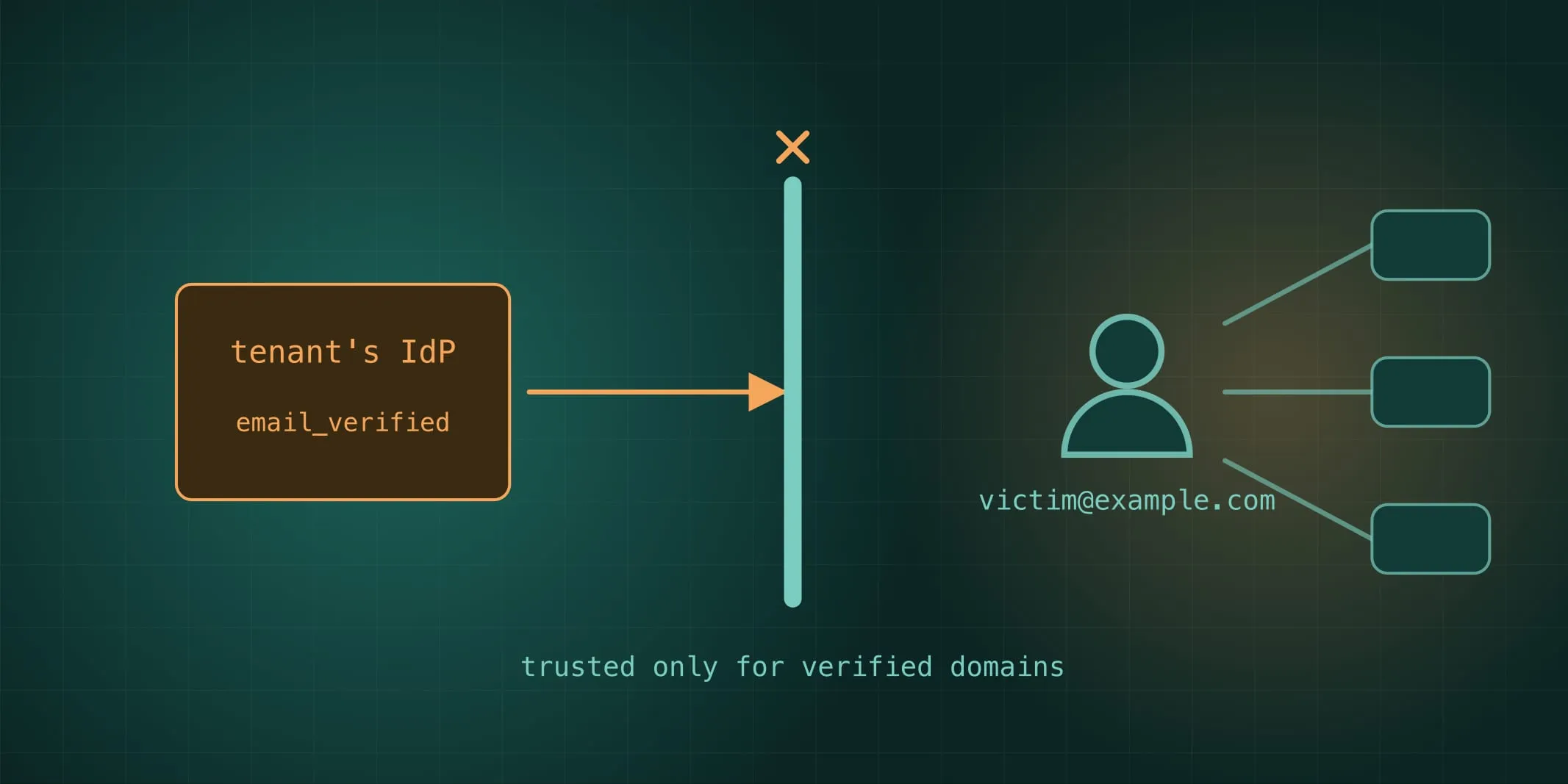
This is the one post in the series that describes a bug we designed in, found in a review, and designed back out. It’s worth a post because the bug is common, and the products that have it mostly don’t know.
The convenient rule
When someone signs in through an identity provider for the first time, you get an email address and often an
email_verified: true claim. If a user with that email already exists, the convenient thing is to link the new
identity to that account. The person who used a password last year and now arrives through their company’s SSO
keeps their history and memberships. Keycloak will do this for you: set trustEmail=true on the identity provider
and pick the first-broker-login flow that “automatically sets the existing user”.
That rule is fine for an identity provider you run. It is not fine for a tenant’s SSO connection.
The attack
Any tenant admin can point their SSO connection at an identity provider they control. That provider can assert
email_verified: true for any address. victim@gmail.com. ceo@othercorp.com.
With the convenient rule, the malicious tenant’s IdP signs in as the victim’s email, the platform finds the existing account, links the new identity to it, and the attacker is now signed in as the victim. Not just in the attacker’s tenant: as the victim’s global account, with every membership it holds in every other tenant. One malicious customer can take over accounts platform-wide.
The rules that replace it
- An email claim from a tenant connection is trusted only for that tenant’s verified domains. If the tenant has
verified
corp.comand bound it to the connection, thenalice@corp.comfrom that connection is trusted. Any other address is recorded as an unverified claim and is never used to link accounts, accept invitations, drive discovery or set the user’s primary email. - Linking to an existing account requires proof of control of that account. When a new identity’s email matches
an existing user, the person re-authenticates as the existing account, or completes a verification email sent to
it, before the link is made. No identity-provider claim links by itself. In Keycloak terms: every tenant IdP has
trustEmail=false, and the first-broker-login flow’s only path to an existing user is “confirm link, then re-authenticate or verify by email”. The automatic authenticator is never used, the realm config is declared in Git, and a test asserts it. - A verified domain grants tenancy decisions, not account ownership. Verifying
corp.comlets a tenant offer SSO to, enforce SSO for, and auto-join people with@corp.comaddresses into its own tenant. It doesn’t let the tenant take over an existing@corp.comaccount or touch that account’s memberships elsewhere. - New users created from an untrusted claim have no verified email until they prove it. An unverified user can’t accept invitations or be found by email for auto-join.
- Attribute sync never changes a primary email silently. A changed email from an IdP is recorded on the identity; the primary email changes only through the verified email-change flow.
- Every link and unlink is a security audit event, and the account’s verified address gets a notification: “a new sign-in method was added”.
The test
The control-plane test suite includes a malicious tenant whose IdP asserts email_verified for an address outside
its domains. The expected outcome is a brand-new, unverified user. It must never link to the existing account, never
join a tenant, never accept an invitation. A second test reads the Keycloak realm configuration and fails if any
tenant IdP has trustEmail=true or an automatic-link flow.
Keycloak’s first-broker-login flow is now part of the security boundary. That’s uncomfortable, and it’s why the flow is declared in Git and the tests re-run on every Keycloak upgrade.
The cost
A person moving an existing account onto their company’s SSO sees one extra confirmation step. That’s it. Against “one customer can take over any account on the platform”, it’s not a close call.