Multi-tenancy by construction, Part 2: Make the forgotten filter return nothing
Postgres Row-Level Security for a pooled multi-tenant database: the table pattern, why FORCE and NOBYPASSRLS matter, setting context per transaction, and composite foreign keys.
In Part 1 we chose shared tables with a tenant_id column.
That leaves the obvious risk: one query without WHERE tenant_id = … and a customer sees someone else’s data.
Code review doesn’t catch this reliably. Neither does an ORM scope that someone can bypass. The fix is to make the database enforce it, so a forgotten filter returns zero rows and a mistaken write is rejected.
The table pattern
Every tenant-owned table gets the same four things:
CREATE FUNCTION app.current_tenant() RETURNS text
LANGUAGE sql STABLE AS $$ SELECT nullif(current_setting('app.tenant_id', true), '') $$;

CREATE TABLE app.projects (
  id         text NOT NULL PRIMARY KEY,
  tenant_id  text NOT NULL DEFAULT app.current_tenant(),
  name       text NOT NULL,
  UNIQUE (tenant_id, id),
  UNIQUE (tenant_id, name)
);

ALTER TABLE app.projects ENABLE ROW LEVEL SECURITY;
ALTER TABLE app.projects FORCE  ROW LEVEL SECURITY;
CREATE POLICY tenant_isolation ON app.projects
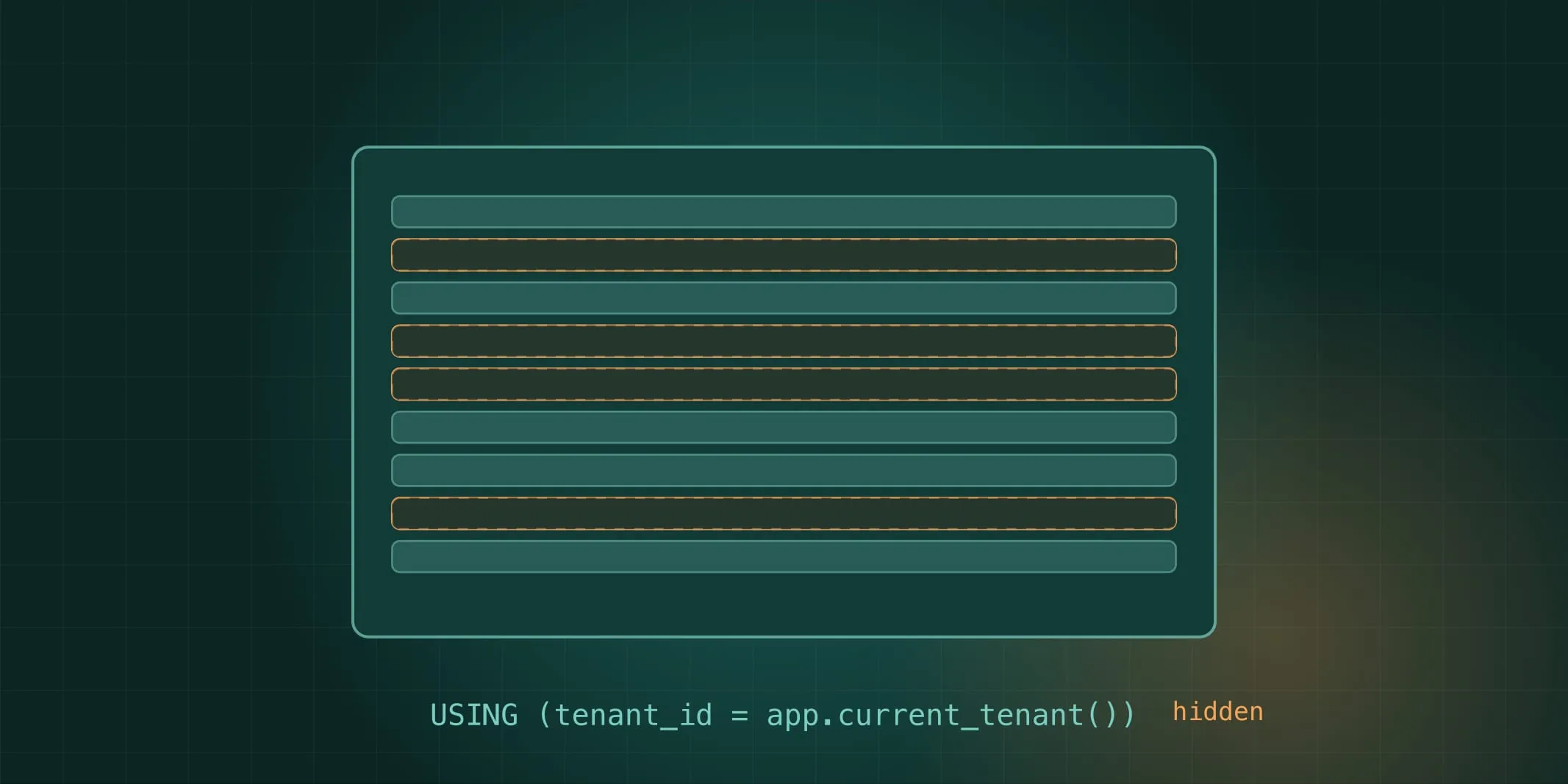
  USING      (tenant_id = app.current_tenant())
  WITH CHECK (tenant_id = app.current_tenant());
tenant_id NOT NULLwith a default from the context. Application code never sets it. An insert picks up the current tenant automatically, and an insert with no tenant in context fails.ENABLEandFORCE.ENABLEalone exempts the table’s owner.FORCEapplies the policy to the owner too, so a migration or a maintenance script run as the owner can’t accidentally cross tenants.- One policy for reads and writes.
USINGfilters what you can see.WITH CHECKrejects rows you try to insert or update into another tenant. When no tenant is set,current_tenant()returnsNULL, the predicate isNULL, and nothing matches. Deny by default. - A runtime role that can’t bypass it. The application connects as a role that doesn’t own the tables and is
created
NOBYPASSRLS. Only migrations run as the owner.
Setting the context
The tenant goes into a transaction-local setting, never a session-level one:
tx<T>(fn: (trx: Transaction<DB>) => Promise<T>): Promise<T> {
  const { tenantId, userId, requestId } = tenantCtx()
  return db.transaction().execute(async (trx) => {
    await sql`SELECT set_config('app.tenant_id', ${tenantId}, true),
                     set_config('app.user_id', ${userId}, true),
                     set_config('app.request_id', ${requestId}, true)`.execute(trx)
    return fn(trx)
  })
}
The true makes the setting last for the transaction only. That matters with PgBouncer in transaction pooling mode,
where the next transaction on the same connection could belong to a different tenant. A session-level SET would
leak across.
This tx function is the only way product code touches the database. A lint rule bans importing the raw pool
anywhere else, so there’s no path that skips the context.
Composite foreign keys
RLS stops you reading another tenant’s rows. It doesn’t stop you referencing them. A document in tenant A could
point at a project in tenant B if the foreign key is just project_id. Make the key composite:
FOREIGN KEY (tenant_id, project_id) REFERENCES app.projects (tenant_id, id)Now the parent has to be in the same tenant as the child, and the database checks it on every write. It’s also why
every table has a UNIQUE (tenant_id, id) constraint even though id is already the primary key.
What RLS does not protect against
RLS makes a forgotten filter fail closed. It doesn’t protect against an attacker who can run arbitrary SQL as the
runtime role, because that role can call set_config itself. SQL injection breaks isolation. So do raw SQL strings
built by hand. The defences for that are separate: parameterised queries only, lint rules banning sql.raw and any
set_config outside the database helper, no DDL for the runtime role, and tests that try to cross tenants.
Keep the explicit WHERE tenant_id = … in your queries too. RLS is the guarantee. The filter is for the query
planner, so it picks the tenant_id-leading index instead of scanning and filtering afterwards.
Next: how to be sure every table actually has this pattern, including the views and indexes that quietly bypass it.