Multi-tenancy by construction, Part 3: A CI gate that fails when a table can leak
Row-Level Security only protects the tables that have it. A migration gate that checks every table, view, function and unique index, and the four ways isolation quietly breaks.
Part 2 put Row-Level Security on every tenant-owned table. The word doing the work in that sentence is every. RLS protects the tables that have it, and a new table added six months from now by someone who’s never read the design doc has it only if something checks.
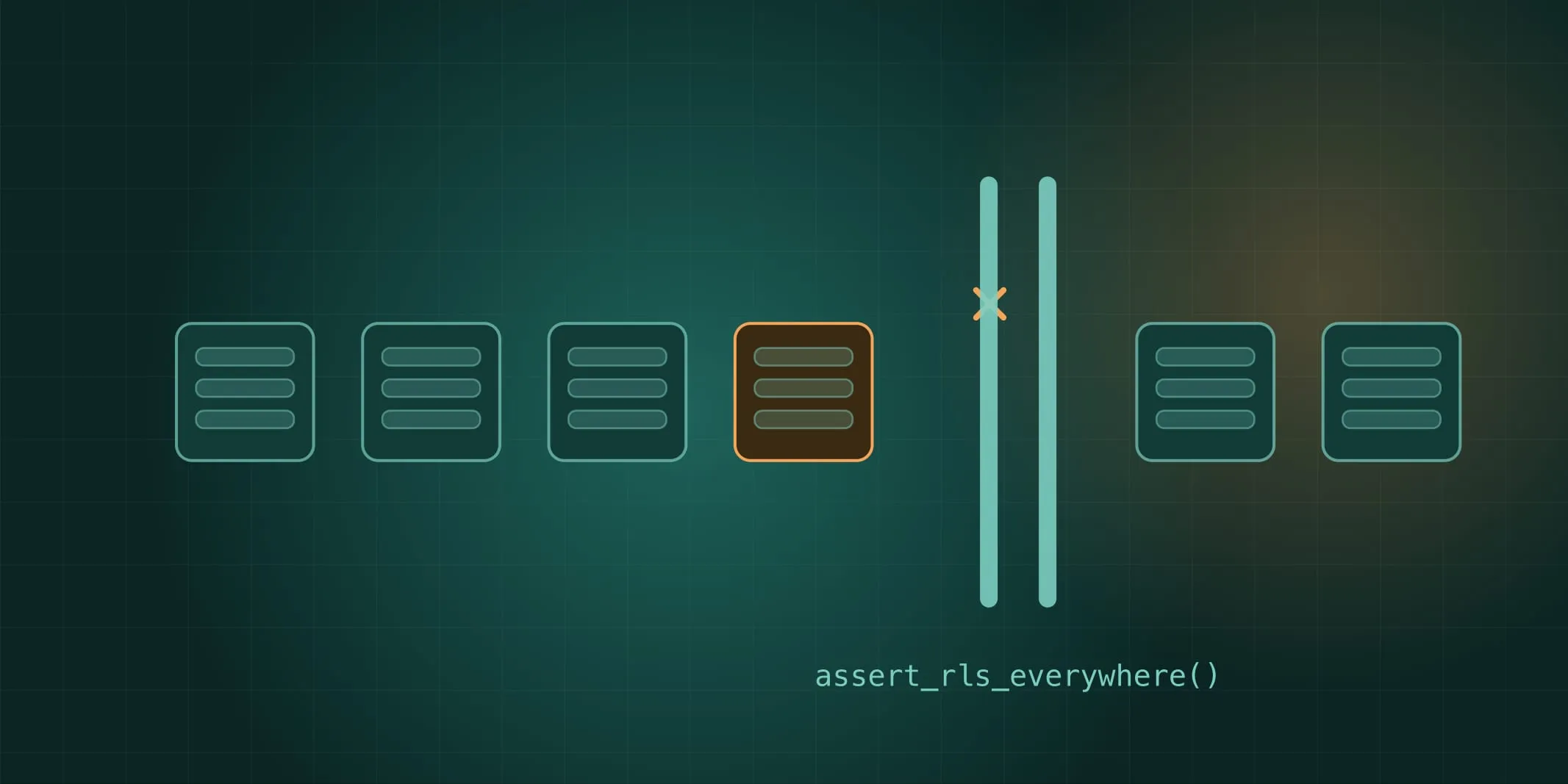
So something checks. After migrations run in CI, a function walks the application schema and fails the build if anything in it could read or reveal data across tenants. New tables are covered automatically, because the gate doesn’t know or care which tables exist.
What the gate looks for
The obvious checks first. Every table in the app schema must have:
- a
tenant_idcolumn that isNOT NULL; - row-level security enabled and forced;
- a policy named
tenant_isolationcovering bothUSINGandWITH CHECK.
Then the four that people miss.
Views run as their owner
A view executes with the permissions of whoever created it, and the owner is the migration role, which RLS doesn’t
apply to unless the view is created with security_invoker = true. A perfectly innocent reporting view over a
protected table returns every tenant’s rows. The gate fails any view in app without security_invoker.
Materialized views have no RLS at all
You can’t put a policy on one. If you need a materialized view, it goes in a separate schema with its own access
rules and its own tenant filtering in the query layer. In app, the gate rejects them outright.
SECURITY DEFINER functions
Same problem as views: the function runs as its owner and skips RLS. Sometimes that’s the point, for a carefully
written helper. The gate allows a SECURITY DEFINER function only if its comment starts with rls-reviewed: and a
reason, so the exception is visible in the migration and in code review.
Unique indexes without tenant_id
This one is subtle. Suppose projects has a unique index on name alone. Tenant B tries to create a project called
“Acme migration” and gets a duplicate-key error, because tenant A already has one. B has just learned something about
A’s data. The gate fails any unique index on an app table that doesn’t include tenant_id. The only exception is a
single-column unique index on a server-generated id.
Testing the gate itself
A gate nobody tests is a gate that silently stopped working. The test suite includes bad fixtures: a view without
security_invoker, a materialized view, an unreviewed SECURITY DEFINER function, and a unique index missing the
tenant column. Each one must make the gate fail. If a Postgres upgrade or a refactor changes the catalog queries,
these tests are what notices.
Per-table isolation tests, generated
Alongside the gate, a test runs for every table, generated from the catalog so new tables are included:
- With tenant A in context, insert a row.
- Switch to tenant B.
SELECT,UPDATEandDELETEagainst that row affect zero rows. - Insert with an explicit
tenant_id = Awhile B is in context. It fails. - Reference a tenant-A parent from a tenant-B child. The composite foreign key rejects it.
- With no tenant in context at all, every table returns zero rows and every insert fails.
None of this is clever. It’s a few hundred lines of SQL and a test file. What it buys is that isolation is a property of the schema that CI proves on every pull request, rather than a convention that holds until it doesn’t.